
Bonneville County Criminal Court Records
A criminal court record is the case file kept by the court after a prosecutor files charges. In Bonneville County, that file can begin with a complaint, information, indictment, or citation and then grow as the case moves through hearings, pleas, motions, orders, trial events, judgment, sentencing, probation review, payment plans, and disposition. The court record is not just a charge list. It is the official case history maintained through Idaho's District Court and Magistrate Division system.
Idaho's court hierarchy matters for criminal records. The District Court is the general jurisdiction trial court, and Bonneville County is part of the Seventh Judicial District. The Magistrate Division handles misdemeanor arraignment, trial, and sentencing, arrest and search warrant proceedings, initial appearances, bail setting in misdemeanor or felony matters, and preliminary felony examinations. Felony trial and sentencing are generally district court matters unless handled under a specific assignment.
For the charge list itself and the arrest-to-charges path, use the Bonneville County arrest records and court charges page. For the broader case file across all record types, use the main court records page.
Search Bonneville County Criminal Court Records
The main public lookup tool is the Idaho iCourt Portal. Bonneville County links to iCourt from its court records and courts pages. Smart Search is used for case status and public case details. Search Hearings is used for hearing dates within a specified date range. Make Payments is available for some criminal and traffic cases, but the portal warns that mobile screens may not work well for payments.
- Open iCourt from the Bonneville County court records page.
- Search by case number when known, or search by defendant name with spelling variations.
- Review the case type, court location, public charges, hearing entries, and docket events.
- Check the disposition and sentence fields before treating a charge as an outcome.
- For copies, certified records, old files, or missing public results, email the county court records request PDF to courtarchives@bonneville.idcourts.gov.
iCourt does not display sealed cases, sealed ICAR 32 event entries, or information exempt by court order. Extended access is limited to approved officials using the system for official duties. Public users who need document copies should contact the county court where the case resides, and Bonneville County lists court records contact at (208) 529-1350.
Bonneville County Criminal Case Flow
Criminal court records are easiest to read as a sequence. The case starts when charges are filed, then a defendant appears before the court, enters pleas, responds to motions, attends hearings, and reaches a plea, trial, dismissal, or other disposition. Sentencing and payment entries come after a conviction or qualifying plea outcome. The docket can also show warrants, bond orders, probation reviews, and failure-to-appear events.
Case flow: Charges Filed › Arraignment › Pretrial / Motions › Plea or Trial › Disposition › Sentencing
| Stage | What Happens |
|---|---|
| Charges filed | The prosecutor files the complaint, information, indictment, or citation that opens the court case. |
| Arraignment | The defendant is advised of charges and enters an initial plea. |
| Pretrial / motions | The court handles bond, discovery, scheduling, motions, continuances, and preliminary felony issues. |
| Plea or trial | The case resolves by plea, trial verdict, dismissal, or another court-approved outcome. |
| Disposition | The case or charge receives a current or final outcome, such as guilty, dismissed, amended, or acquitted. |
| Sentencing | The court enters jail, probation, fines, costs, restitution, treatment, withheld judgment terms, or other sentence conditions. |
The Idaho failure to appear statute is relevant when a criminal docket shows missed court and possible warrant consequences.
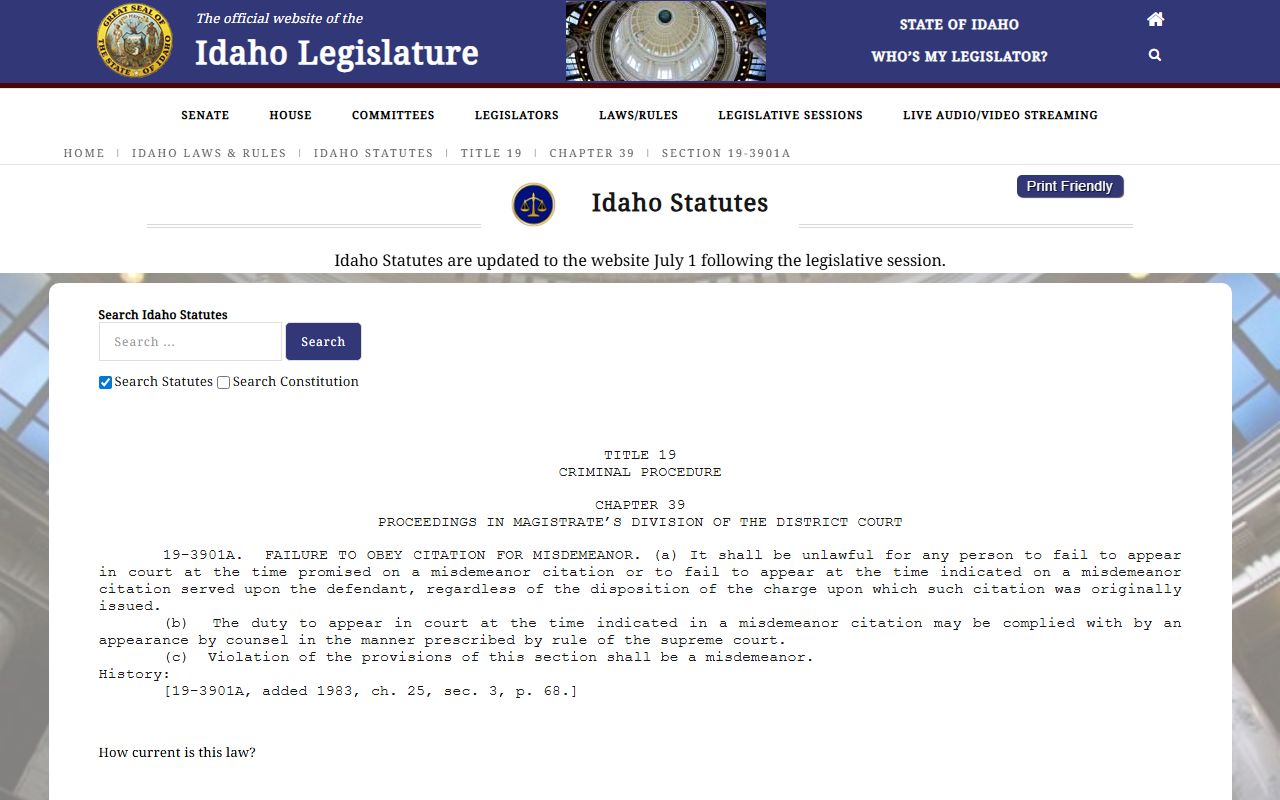
Failure-to-appear entries can affect bond, warrants, and later criminal court record events in Bonneville County.
What Bonneville County Criminal Records Show
A public criminal case record can show basic case data and key events, but it may not show every document. Expected fields include case number, court or location, defendant, prosecutor, defense counsel, filed charges, case type, filing date, status, hearing dates, docket entries, public disposition, payment eligibility, and sentence details when public. Sensitive identifiers, sealed event entries, juvenile records, and protected information are redacted or withheld.
| Field | What It Shows |
|---|---|
| Case number | The Odyssey or iCourt identifier used by the court and clerk. |
| Defendant | The person charged in the case, unless the matter is sealed or restricted. |
| Charges | The filed criminal counts, citations, or amended counts, with severity when shown. |
| Attorney fields | Prosecutor, private defense counsel, or appointed public defender when public. |
| Docket entries | Arraignment, plea, preliminary hearing, motion, order, warrant, sentencing, probation review, or payment event. |
| Plea | The defendant's plea to a charge, such as guilty, not guilty, or another accepted plea entry. |
| Disposition | The result or current status of each case or charge. |
| Sentence | Jail, probation, fines, restitution, costs, treatment, or other ordered terms when public. |
The Bonneville County Prosecuting Attorney page names Randy Neal and describes the office that files and prosecutes county criminal charges.
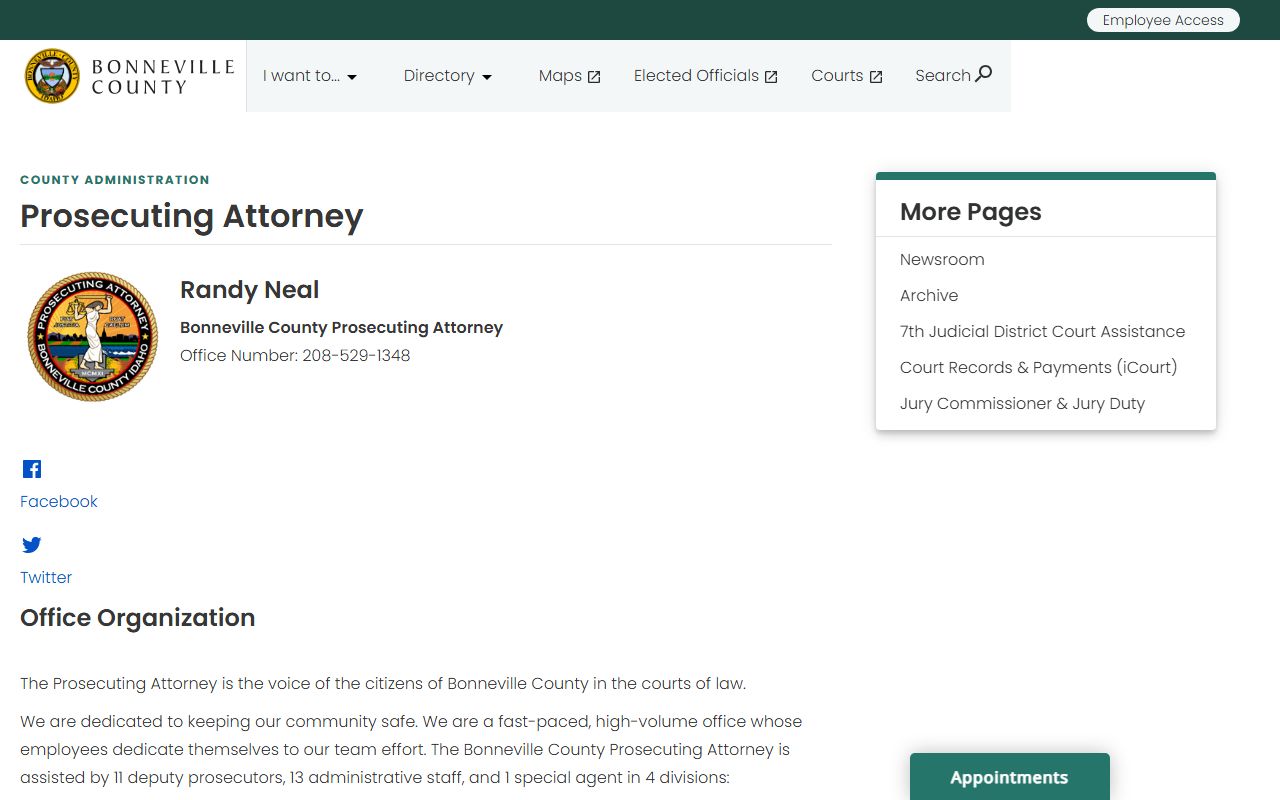
The prosecutor's role explains why charges appear in a criminal court record after law enforcement activity has been reviewed for filing.
Criminal Charges vs Convictions
A filed charge is an accusation in court. A conviction is a court outcome after a guilty plea, verdict, or other qualifying adjudication. Bonneville County criminal court records can show charges that are pending, amended, reduced, dismissed, or resolved without conviction. That difference is central when reading criminal records, because a charge line alone does not prove guilt.
| Point | Charge | Conviction |
|---|---|---|
| Stage | Filed accusation in the court case. | Outcome after plea, verdict, or qualifying adjudication. |
| Proof level | Based on charging and probable-cause process. | Based on a guilty plea, trial verdict, or accepted court finding. |
| Record effect | May remain as a docket or charge entry even if later dismissed. | Supports sentence, fines, probation, or other court orders. |
| How to confirm | Read the current charge status and later entries. | Read disposition, judgment, sentencing, and relief entries. |
Read Dispositions and Sentences
Disposition means the result or current outcome of a case or charge. Common criminal record outcomes include guilty, dismissed, not guilty, amended, reduced, transferred, stayed, or closed. A sentence can include jail, probation, fines, restitution, treatment, work release, or other court-ordered terms. Bonneville County's court records may also show payment eligibility for criminal cases through iCourt's payment function.
Idaho's withheld judgment and dismissal framework can appear in criminal records. Under Idaho Code section 19-2604, eligible cases may receive withheld judgment or dismissal relief. That relief should not be described as a universal adult expungement. It is case-specific, statute-specific, and different from erasing every record from every public or agency system.
The withheld judgment statute is a key source for reading Idaho criminal record relief entries.
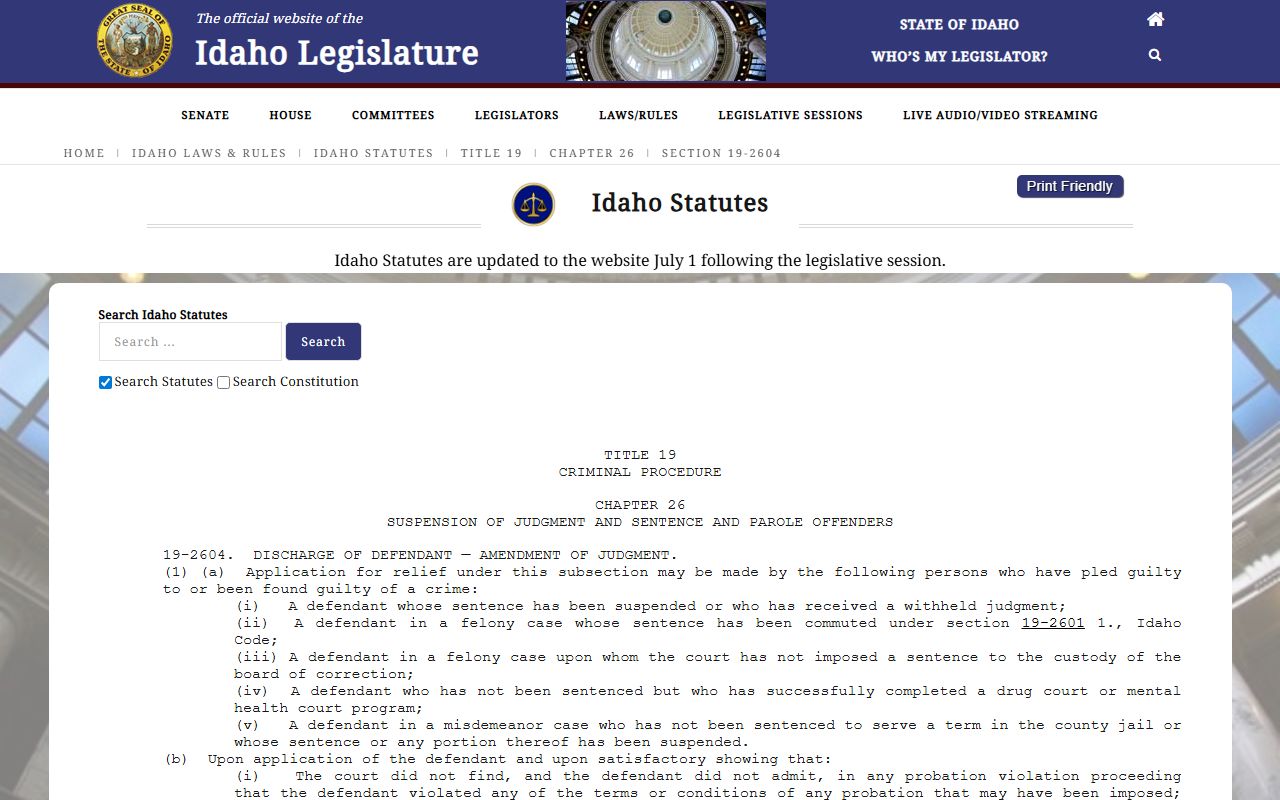
A withheld judgment entry should be read with the final disposition and sentence terms rather than treated as a simple deletion.
Sealed and Expunged Criminal Records
Sealed records are hidden from general public access because a statute, rule, or court order restricts them. Expungement is a statutory process that removes or seals eligible records under a specific law. Idaho is not a broad adult expungement state. Juvenile expungement is specifically authorized for qualifying juvenile cases, while adult relief is more limited and often tied to withheld judgment or dismissal rules.
| Point | Sealed | Expunged |
|---|---|---|
| Public visibility | Hidden from public iCourt and public inspection when the sealing rule applies. | Removed or sealed through a qualifying statutory expungement process. |
| Common source | Court order, ICAR 32, juvenile rules, or confidentiality law. | Juvenile expungement under Idaho law, plus limited case-specific relief. |
| Where filed | Through the case court or the court controlling the sealed record. | Juvenile petitions are filed where the juvenile disposition was entered. |
| Practical limit | An order to seal may remain public even if the sealed item is not. | Adult dismissal relief does not make every record disappear from all systems. |
The Idaho juvenile expungement statute is the research source for qualifying juvenile criminal-record relief.
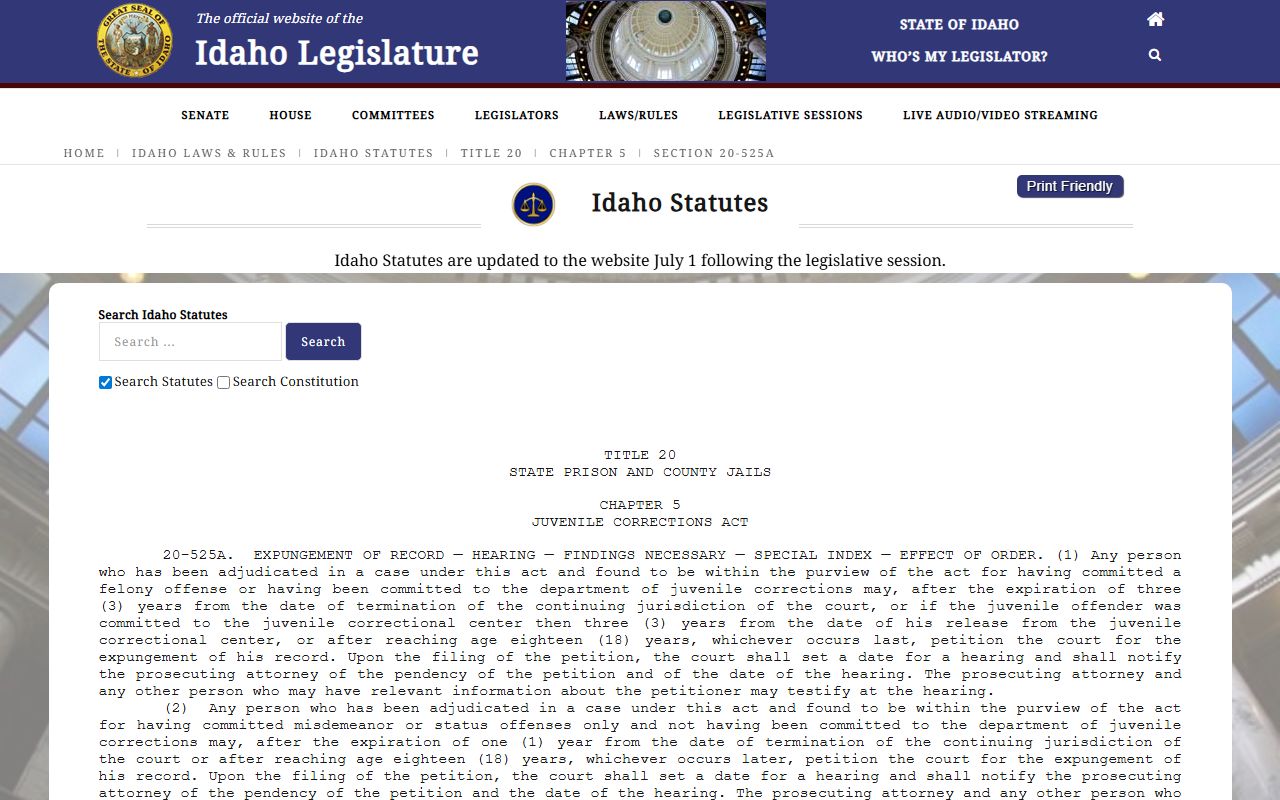
Juvenile expungement in Bonneville County is handled by petition and court order, not by a general public-records request.
Public Access to Criminal Records
Public access to Bonneville County criminal court records is governed by both public-records law and court-record rules. Idaho Code section 74-102 starts from a public right to inspect and copy public records unless an exemption applies. Idaho Court Administrative Rule 32 supplies court-specific confidentiality rules for court records.
The Bonneville County Public Defender page explains that court-appointed defense is assigned by Bonneville County Courts for indigent defendants in misdemeanors, felonies, juvenile matters, mental commitments, guardianships, and other assigned cases.
Public defender entries can appear in the court record when counsel is appointed, but eligibility and appointment are handled through the court case.
The Idaho State Public Defender contact page lists the Bonneville County Main Office at 510 D. St., Idaho Falls, ID 83402.
The local defender office is relevant to criminal case files because appointed-counsel status is a court-case event, not a sheriff record.
Note: Public criminal court records can be incomplete online when a document requires clerk review or extended access.
Restricted Bonneville County Criminal Records
Restricted criminal records include juvenile cases, sealed cases, sealed event entries, mental-health related proceedings, protected addresses, minor names, financial identifiers, medical information, and safety-sensitive victim information. Active search warrants may also be sealed while investigative. A public iCourt search should not be treated as a complete criminal-history background check, and absence from public results does not prove no record exists.
For a public case that does appear online, the safest reading is field by field: filed charges, current charge status, plea, disposition, sentence, and any later relief entry. For copies, contact the court records office or use the county court records request process.